Thursday, January 30, 2020

Fraser Canyon and Tunnel 34

Looking east into the Fraser Canyon. Photographer unknown.
The last scene on the mainline in my plan for the layout is a bit of the eastern end of Fraser Canyon leading up to Tunnel 34. This is an isolated stretch of railroad where access is pretty much by foot, via the river, or by rail. It is a popular fishing spot, and I have found a few pictures from the train, but not a lot otherwise in the canyon. In some ways, this is perfect for the end of the modeled mainline. Just plain mountain scenery.

Amtrak passing the cleanup from a Fraser Canyon rock slide in May 2004. Photo by HemiAdda2d.
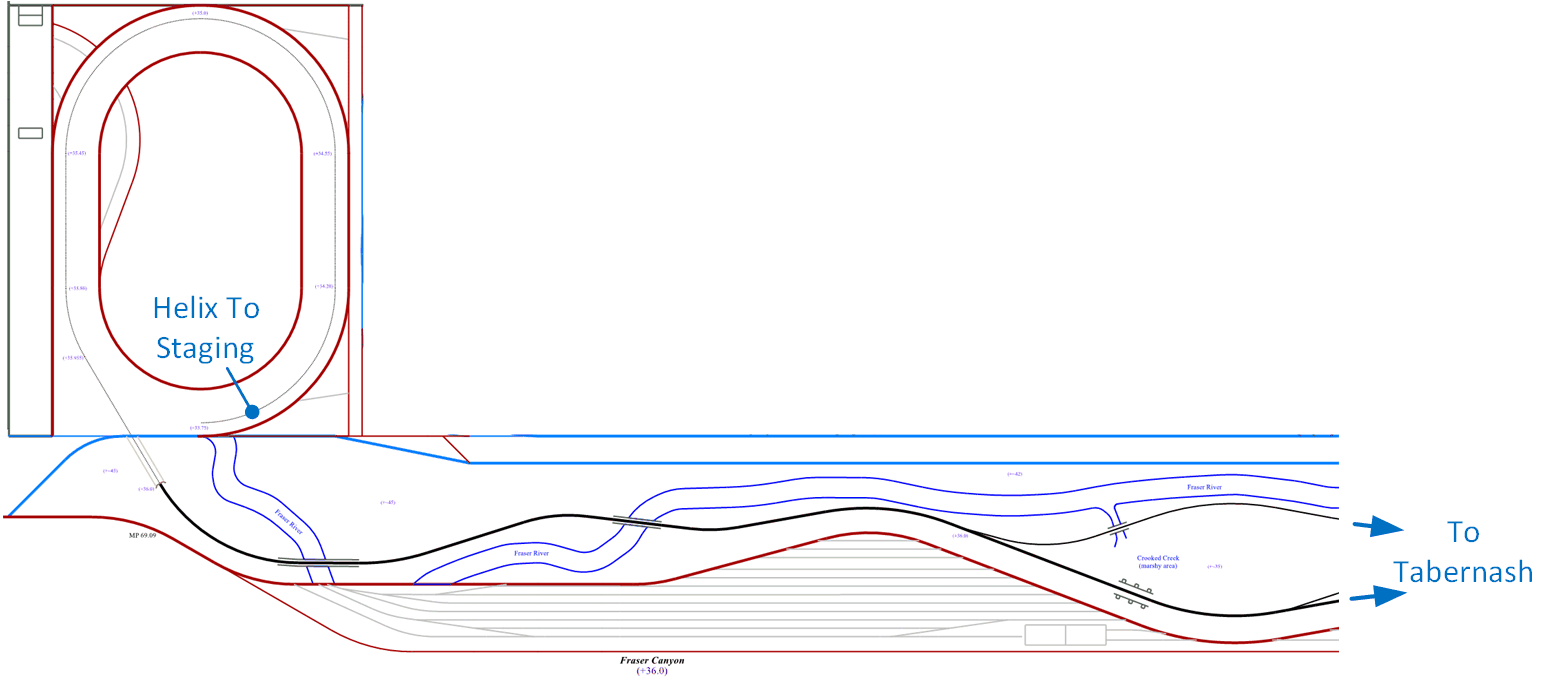
The track plan for the Fraser Canyon section of the layout extends from the western end of Tabernash to the wall by the door. At that point, the mainline turns to enter Tunnel 34 in Fraser Canyon. The portal of Fraser Canyon leads into the upper reaches of the helix that will connect to staging and provide a continuous run connection back to Denver. The scenery is going to be heavily tree covered canyon walls, with two bridges modeled in the canyon. The scene is simple, but should provide a connection to the rest of the world and will help hide the connection back into the helix and staging.

Track Plan for Fraser Canyon

So, that is the mainline plan from Denver Union Station to Tunnel 34 in Fraser Canyon just west of Tabernash Colorado, 69.1 miles to the west of Denver. All modeled in 3+ decks. It is an exciting layout concept to be sure and would be an awesome site to see.

Cameron Turner

Wednesday, January 29, 2020

Wordless Wednesday

July 13, 2014 sees UP1982, the MP heritage unit lead an empty salt train into Rollinsville. Behind UP1982 is a NS engine, bringing a little classic black back to the UPized Moffat Line. Photo by John Shine.
Cameron Turner

Monday, January 27, 2020

A Momentary Aside - Doug Midkiff

I rebooted this blog last June after my own health scare. This weekend, as I was doing a little work on the Central T-Layout, I got a message through one of my old operating group friends that a student, colleague and fellow N-scaler is going through much the same thing as I did - but his prognosis is not as hopeful as mine.

Doug and his family.
Doug Midkiff was one of the first graduate students I had as a professor. Not only was he a great student, but I soon learned that he was a model railroader and an N-scaler. I soon got Doug involved in a local operating layout I had joined and we remained in contact until I changed jobs a few years ago. In fact, Doug encouraged me to produce an innocuous little part for some N-scale engines he was painting and detailing, and that helped lead to me starting a Shapeways store. Amazingly enough, this little detail is by far my best selling item....not that it will let me retire from the proceeds ... ever.

Rock Island Cooling Assemblies
I learned this weekend that Doug has developed stage 4 colon cancer and has been placed in hospice care. While we pray for the best, we know that there is an uphill fight ahead for Doug. Doug has a wife and young daughter. They have started a GoFundMe page to help cover some expenses. As of this morning they are almost 2/3rds of the way to their goal.


Please pass the link along and consider whether you can find a little hobby money to help them.


All our prayers go out to you and your family Doug.

Cameron Turner

Wednesday, January 22, 2020

Tuesday, January 21, 2020

Welcome to Tabernash!

Things continue to be very busy at the start of the semester, so I am trying to squeeze in a couple of quick posts. Today, welcome to Tabernash Colorado!

Tabernash is a small community at the western end of the Winter Park Valley. To the west, the main line enters Fraser Canyon. To the East, the grade steepens to 2% as the line runs up to the Moffat Tunnel. Tabernash is the site of a long siding, a reverse loop connected to a wye, and is currently a layover location for the Ski Train. In the past, Tabernash was also a helper location where engines were added for the run up to the Moffat Tunnel. In more recent times, these helpers were used as swing helpers, running all the way to Denver to provide braking on the eastern descent from the Moffat Tunnel.

Eastbound DRGW 5361, 5369, 5358, 5370, and 5368 lead a coal train east out of Tabernash in November 1976. Photo from CarrTracks. 
 All of these make Tabernash desirable to include in the layout, if only to be able to model these different operational elements.

The Ski Train waits at Tabernash. Mike Danneman Photo.
The western end of Tabernash crosses a brief bit of ranch land as it enters Fraser Canyon. Here the main line is isolated from the road, making Fraser Canyon on of the more remote sections of the Moffat Line.

The siding wraps around Tabernash. You can see the freight on the left on the siding (old main), while Amtrak takes the new main on the right. Photo by Michael Harding.
To model Tabernash, I located it below East Portal, and above North Yard. The old main representing the siding wraps around the blob that contains the Moffat Tunnel Helix, providing a lot of length, while not lengthening the scene too much. The resulting siding is 216 inches long, making it the second longest siding on the layout to Rollins. Prototypically, it should be longer than Rollins, but the siding is long enough to hold any train I plan to run. I have added a pair of spurs to the town to allow for a team track and a local industry or two, just to have a little bit more operational capability.

Track Plan for Tabernash, CO.

Tabernash will reside almost 3 feet above North Yard, and given that there is only a little bit of operations there, I think it should not interfere too much with North Yard Operations. The nod-under at the wye for Tabernash will also have a clearance of more than 5 feet, so it will be a nod-under. However, its presence may also encourage folks to resist the temptation to pass into the North Yard area, and instead walk around the bookcases (representing the bottom of the aisle) to see their train from the Fraser Canyon end. Tabernash is also about 14 inches below East Portal, so there should be reasonable clearance between the two scenes.


Cameron Turner

Wednesday, January 15, 2020

Wordless Wednesday

DRGW3123 leads the Ski Train west of Fraser Colorado in March 1985. Photo by Dave Ori.
Cameron Turner

Wednesday, January 8, 2020

Wordless Wednesday

UP1989 Crosses the Fraser Valley leading the ski train in February 2007. Photo by Chris May.
Cameron Turner

Sunday, January 5, 2020

To Where the Ski Train Waits

Amtrak Station Sign at Fraser Colorado. Photo from Wikipedia.
Fraser Colorado (elevation 8574') often makes the news due to it being one of the colder spots in the continental United States. It is also the Amtrak stop for Winter Park, and hosts a short siding (length 4830') that is sometimes used to store the Ski Train prior to its journey east from Winter Park to Denver. The siding is too short to be useful for most trains, but passenger trains are another story.

The town of Fraser Colorado looking West. Photo from Colorado.com.
Fraser sits in a valley between mountain ranges in the Rockies. This is the typical terrain on the western slope; the DRGW ran through an obstacle formed by a mountain range, across a valley, and then through another obstacle. Often, you find a town at each edge of the valley and one in the middle. Generally, we find a siding at each location. Understanding this configuration is important from a modeling standpoint.

West of the continental divide, we see the towns of Winter Park (siding), Fraser (siding) and Tabernash (siding) after which the DRGW passed through Fraser Canyon. The Continental Divide and Fraser Canyon become the obstacles. This pattern is repeated as the line continues west. Exiting Fraser Canyon, the mainline encounters Granby (siding) crosses the valley of Grand Park (park is a term often used for these mountain valleys) to Hot Sulphur Springs (siding) and enters Byers Canyon. Again, exiting Byers Canyon, we have the sidings of Flat and Troublesome before reaching the town of Kremmling (siding) and Gore siding before entering Gore Canyon.

If I had the space to continue west, I would look at this pattern: Obstacle - Siding - Obstacle - Siding, etc. as a plan for the layout. But for the task of modeling the Fraser Valley, specifically for Ski Train operations, I had to look at this pattern differently. Winter Park is needed since this is where the Ski Train stops to let the skiers disembark. Fraser is where Amtrak stops. Tabernash is where the Ski Train is turned and often lays over in the siding during the day, although Fraser is sometimes used once Amtrak has cleared the area. I did consider combining Fraser and Winter Park, or combining Fraser and Tabernash as an alternative, but ultimately decided to model all three.

Track Plan for Fraser.
My model of Fraser captures some of the town and the siding (83 inches long, sufficient for about a 12 car passenger train with 4 engines) and the spur track that served a lumber facility. I plan to place a small sawmill on the spur that is being used to process trees killed by the bark beetle infestation in the area. I also added a spur off the team track that can be used as a team track for the town.

Travelling the Fraser Valley.
Continuing across the Fraser Valley, the scenery is limited. There is a crossing of Saint Louis Creek, but otherwise it is ranch land. Since the track will run along a narrow shelf, this kind of "nothing-to-see-here" scenery should give a feel of separation. I did decide to place a lake or pond near the western end of the scene as a few bodies of water began to appear as the line approaches Tabernash. These features are often created by low spots flooded by the Fraser River which the line will follow through Fraser Canyon.

The Ski Train crosses the ranch lands west of Fraser. Photo from Tom Brynas.
Cameron Turner

Wednesday, January 1, 2020

Wordless Wednesday

UP1996, the SP Heritage Unit leads a train east out of Pinecliffe in December 2015. Photo by John Shine.


Happy New Year!


Cameron Turner

Tuesday, December 31, 2019

A Review of the 2019 – Previewing 2020


I had actually hoped to post a few more entries before getting to this post, but the year is ending on me, and I have not even reached the end of the Moffat layout yet. So, let's have a little review.

Technically, the year began with some updates on the Central T-gauge Layout and its latest showing. And then my health took a bad turn. That layout sits as it did after the show last year, although it is showing a little bit of peeling of the backdrop, it is otherwise unchanged - and the annual show for its display is coming up. If you are in the Easley, South Carolina area on February 7th and/or 8th, please check out the Central Train Show.


I got back to blogging in June, 3 months after my surgery. Since then, I have focused a great deal on the design of a couple of layouts, including my future Moffat layout. With this post, I have posted 11 times in July, August, September, October and December, and every day in November. A whopping 88 posts since June 22nd.

As far as model railroading progress, I only have a little beyond the planning stages. I'm hoping to finish installing the bookshelves in my office over the winter break, as a prerequisite to the Olympia iN the Office layout, which you can read about beginning here.


In addition, I designed the signals for Bob Folsom's layout, and hopefully will see those operational this year. They will be coming to Shapeways in the New Year.

Beyond that, a lot of time has been spent on the entries describing the layout plan. This is a good thing, as the research to support the blog posts has led to more information about the layout.

So, what is the plan for 2020?

With the train show upcoming, I have a number of items I should tackle for the T-layout. These include:
  • Installation of the pedestrian bridge;
  • Repair of the backdrop;
  • Installation of the roads;
  • Weathering of the two viaducts;
  • Painting of the buildings; and
  • Starting the ground cover.
Finally, I should get the T in Central Blog going, so that the club can link to the blog specifically about the T layout.

On the Moffat Layout, I also have a number of things to do:
  • Finish the blog about the design - I actually have a lot more progress than what I have described so far, so I am playing a little bit of catch up here; and
  • Start prioritizing projects that will lead to parts of the layout.
And in general for my model railroading, I hope to:
  • Select some short term mini-layouts that may either lead to the Moffat Layout, or will test out ideas for the Moffat Layout, or will just be fun, more on these to come as I also have some ideas floating around;
  • Finish my HOn2z cars for the next NMRA regional meeting as part of getting my MMR; 
  • Start designing the accompanying HOn2z engines; and
  • Have fun.
In that spirit - here is something to share for the season.


So, in the mean time - Happy New Year to all, and may your Model Train Dreams be bright!

Cameron Turner