Showing posts with label Staging. Show all posts

Tuesday, March 10, 2020

The Branches: The Belt Line and Nebraska Staging

One of the parts I like the plan is the inclusion of several branch lines off the main. Located above Rennick Yard and Union Station, I found room for a representation of the Belt Line. The actual Belt Line leaves North Yard through Utah Junction and crosses through the northern industrial end of Denver. It serves multiple industries and connects to the Union Pacific yards. It also used to host Rock Island trains coming in from the eastern plains that used North Yard as their Denver terminus.

My version of the Belt Line is freelanced, but takes inspiration from the actual Belt Line. Many of the industries are to be found around Denver if not on the Belt Line.

Prospect Yard on the Belt Line.
The first stop on the Belt Line is a freelanced yard called Prospect Yard after a yard that was once in the area. My intent is that this yard will serve as visible staging for the Belt Line when the rest of the railroad is in operation. Because of aisle space concerns for operators, I decided that the Belt Line will operate in between operating sessions of the Moffat Line layout and it is designed for 1-3 people to work different switching jobs. In fact, these switching jobs need not even run between operating sessions, as the staged trains can simply be reused to connect to North Yard.

Prospect Yard provides a connection to the UP and an engine servicing facility. In many ways, it is inspired by the Burnham yard and shops complex south of Union Station. In fact, along the backdrop I plan to model the Gates Rubber Company plant from south Denver. From Prospect Yard, Belt Line trains head to the upper left across the South Platte River to the rest of the Belt Line via a wood pile trestle inspired by one one the modern Belt Line,

For operational purposes, I plan a single switching job working the industries around Prospect Yard called the Short Belt Job. Cars for the Short Belt Job would arrive from North Yard via a transfer run. In Prospect Yard, an as yet unnamed but freelance short line that would do the switching on the Belt Line. Cars coming from the industries switched by the Short Belt Job would be returned to Prospect Yard for a transfer run to North Yard. Transfer runs from the UP might drop or collect cars for the UP in Prospect Yard, and would run through to the D&RGW North Yard.

PSC Loop on the Belt Line.
At the east end of the Belt Line, lies the Public Service Company of Colorado Cherokee Power Plant. Coal off the Moffat powers this plant. I located it closer to the west end of the Belt Line to fit the space, and allow me to have a loop where loads and empties can be exchanged wrapped around the Helix. Runs to the power plant would be handled by the PSC Job out of Prospect Yard, or even out of North Yard (running through Prospect Yard).

Belt Line to Sandown Yard.
The next part of the Belt line consists of a pair of switching districts. The first is on the left side, centered around the PSC area that I am calling Washington Park. In practice, the Belt Line would support and additional job called the Washington Park Job to switch the non-PSC industries in the area.

The second group of industries in located near West Sandown Yard on the right side of the plan. West Sandown Yard is imagined as an interchange yard with a shortline called the Colorado, Rock Island and Pacific that serves the agricultural areas of eastern Colorado. The job to work these industries would be called the Long Belt Job. In addition, there may be transfer runs between West Sandown Yard and Prospect Yard.

Nebraska Staging.
The imagined CRIP connects via Sandown Junction and uses a helix under West Sandown Yard to drop to the Nebraska Staging Yard, which consists of 4 tracks and a reverse loop. Each track is about eight feet long.

Stockyard Branch.


Also located near West Sandown Yard is Stockyard Junction. Stockyard Junction connects to the Stockyard Branch which reaches the end of track at the fictional location of Airy. A fifth switching job, called the Stockyard Job would run from Prospect Yard to these industries.

I think that the Belt Line would be a neat layout in its own right, although it lacks some of the overhead traffic I would like to model. But, it does provide a promising addition to the Moffat Layout.

Cameron Turner

Saturday, February 22, 2020

Staging: Montana and Phippsburg

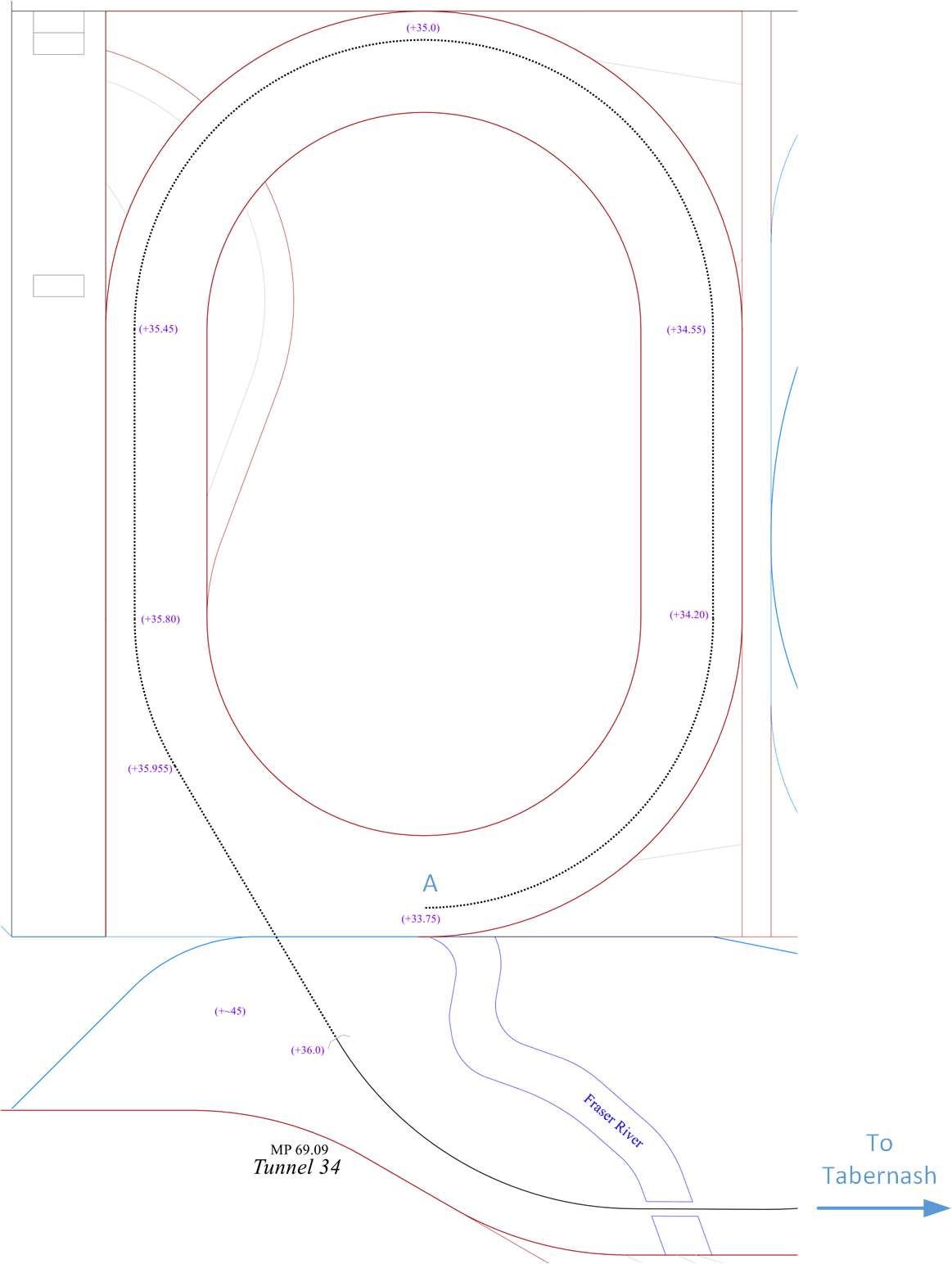
The BNSF line north out of Denver is connected to the main layout via a helix that drops down below the layout just to the layout-west side of Cargill. This line would head north to Cheyenne Wyoming and on to Montana, so I decided to call its staging yard Montana. Some of the traffic off of this line would run through Denver to the Joint Line, so it also needs a connection to the main layout helix. I also wanted to add some additional staging for the Craig Branch (called Phippsburg Staging). The majority of this traffic would be coal loads headed east over the layout and empties heading west. At the time I am modeling, there could be 6 trains each way per day, plus a local freight. That amount of traffic would take up a lot of space in the Granby/Utah yards, making it difficult to stage without some dedicated tracks. This too connects via the main helix. Both of these yards are located below the layout in the garage part of the space.


Connection to the Montana and Phippsburg Staging Yards.
This will require a penetration of the wall, but it should be workable. The connection point A leads to the Montana Staging Yard, located under the benchwork for the Arvada and C&S Junction part of the layout. The yard is actually two yards, a through yard, and a loop yard. The loop yard can send traffic to either the Joint Line or the BNSF Northern connection.

Montana Staging Through Yard with the connection to the BNSF Northern Helix.
BNSF Montana Loop Staging Yard. 
The two staging yards have a total of 10 tracks. The through yard tracks run between 152" and 175". The loop tracks run between 206" and 233". These tracks can be used to represent the north-south traffic through Denver on the BNSF. I did choose to arrange these yards on the side of the benchwork where there will be an elevated walkway for operators. This allows the other side of the benchwork to be used for storage under the layout - something we need in the house.

Phippsburg Staging Yard.
The Phippsburg Staging Yard is located under the Barbara Gulch area of the layout. It consists of 6 tracks between 366" and 395" in length, allowing each track to hold two trains. Thus the layout will have enough room for 12 coal trains (6 loaded and 6 empty). The trains would run in a sequence of loads heading up the main helix all the way to Fraser Canyon, running down the layout and for through trains, back into the helix at Prospect Junction headed for the Joint Line. There, the trains would again climb the helix to Utah Staging, take the loop and run back down the helix to Phippsburg Staging. Empties would run in the reverse process. Unfortunately, that does lead to a bit of a long hidden run between Prospect Junction and Phippsburg, but I was not able to avoid it.

Cameron Turner

Friday, February 21, 2020

Staging: Pueblo, Kansas, UP Wyoming, Utah and Granby

In any layout like mine, the staging plan is important. In my case, from Denver, I have staging connecting to Pueblo/Kansas (DRGW), Wyoming (UP), Montana (BNSF), Utah/Granby (DRGW) and what I am calling Phippsburg for the DRGW Craig Branch.

The main line from Tabernash enters the helix and make a loop to drop down to the upper staging yards representing points west. I named the two yards Granby (the next town west) and Utah (the ultimate destination.

Western Slope Helix Entrance. Point A, connects to the next lower lap of the helix.


Granby/Utah Staging Interface with the Helix. Point B continues down several laps to the Pueblo/Kansas staging yards.

Granby and Utah Staging Yards.
The Granby Staging Yard consists of 10 stub ended tracks, each between 181" and 196" long. The wye connection to the helix allows trains to enter from or depart to the eastern end of the layout (down the helix), or to the western end of the layout (up the helix). To turn trains, the Utah staging yard is used, and is connected to the helix also via a wye. Trains can easily pass between the two staging yards to be turned with limited impact on the helix. The Utah Staging Yard has 5 loops between 394" and 423" long, allowing for trains to be staged elephant style. Utah and Granby reside below Winter Park and Fraser on the layout.

Taking a couple more turns of the layout via point B, allows access to additional staging yards.

Pueblo/Kansas/Wyoming Staging Yard Connections to the Helix.
The Pueblo/Kansas and Wyoming staging yards connect similarly to the helix as the Granby/Utah staging yards. The primary difference is with the Wyoming Staging Yard for the UP connections to Denver. It is accessed from the eastern end of the layout only and so receives or dispatches trains only to that end of the layout.

UP Wyoming Staging Yard.
Trains to/from the UP in Wyoming use a stub ended staging yard on the western wall of the layout room. These trains will not automatically restage and will need to be worked between sessions. However, these trains represent yard transfers to the DRGW at North Yard, and so four tracks should be sufficient for two operating sessions and restaging may simply involve swapping power end to end. The tracks range from 110" to 118" in length. This yard ends up below the line between Fraser and Tabernash.

Pueblo/Kansas Staging Yards.
The Pueblo and Kansas staging yards look identical to the Granby and Utah yards above with 10 and 5 tracks respectively of the same lengths as the yards are the other ends. I may decide that a single set of yards is sufficient, but extra staging is usually useful. One thing to note is that the Kansas Staging Yard also will be needed to turn BNSF trains southbound on the Joint Line to send them to the BNSF Montana staging yard located elsewhere in the layout space. This is the result of the configuration of Prospect Junction with respect to the helix, which directs Joint Line trains to climb the helix, while the BNSF trains headed North out of Denver drop down to a lower staging yard.

To complete the overview of these staging yards, I also have included the next helix lap down below the Pueblo/Kansas Helix interface. This gives a complete picture of how trains enter/exit the Pueblo/Kansas Staging Yards.

Lower helix connection to the Pueblo/Kansas Staging Yards. Note the line at D, which connects to the Pueblo Staging Yard.
All in all, finding a configuration of yards that gave me the capacity I wanted, along with the flexibility to turn trains and exit either east or west, was a challenge. But it works. These staging yards all fit in on shelves above the scenic sections of Renneck Yard/Union Station on the lower deck, and below the scenic sections of Winter Park and Fraser on the upper deck.

I have also mentioned Montana and Phippsburg previously, but I will save those for the next post.

Cameron Turner