Showing posts with label Fraser. Show all posts

Wednesday, September 16, 2020

Wordless Wednesday


An SP Patch (UP6361) leads two more UP units west towards Fraser, Colorado. Photo by John Crisanti.

Cameron Turner

Wednesday, August 12, 2020

Wednesday, August 5, 2020

Wednesday, July 29, 2020

Wordless Wednesday


Amtrak passes through a winter wonderland outside of Fraser, CO in 2003. Photographer Mike Danneman.

Cameron Turner

P.S. I just found out this photo is another one of Mike Danneman's great work. See more of his work at his flickr site.

Tuesday, February 18, 2020

Deck 3 Overview – The Western Slope

So, it has been a while since I talked about the plan for the dream layout. And there is a reason for that. The morning of the Central Model Train show, we had flooding in the crawlspace accessed in the upper right hand corner of the drawing below. While there was no damage, we identified that the sump pump in the space had failed, and that some of the equipment in the crawlspace is in need of annual maintenance. Surprise!

The previous owner had not told us that the crawlspace items needed annual maintenance and thus regular access. So, it looks like I will need to rework the plans to allow easier access to this opening. Pity, I really liked how this plan had come together and had gone so far as to detail all the buildings, roads, water, and even signals into the layout. But alas, the next iteration will be even better.

In the meantime, I figure I can finish going through the plan as it stands now...or as it stood. 

Deck 3 - Western Slope Plan.
So, here is the western slope as modeled. From Winter Park, the line descends through Fraser and into Tabernash before exiting the layout to through the upper reaches of the Fraser Canyon and entering into the helix. The helix would provide access to staging, and would connect back to the mainline at Prospect Junction - allowing for continuous restaging and continuous running when desired.

Cameron Turner

Wednesday, January 15, 2020

Wordless Wednesday

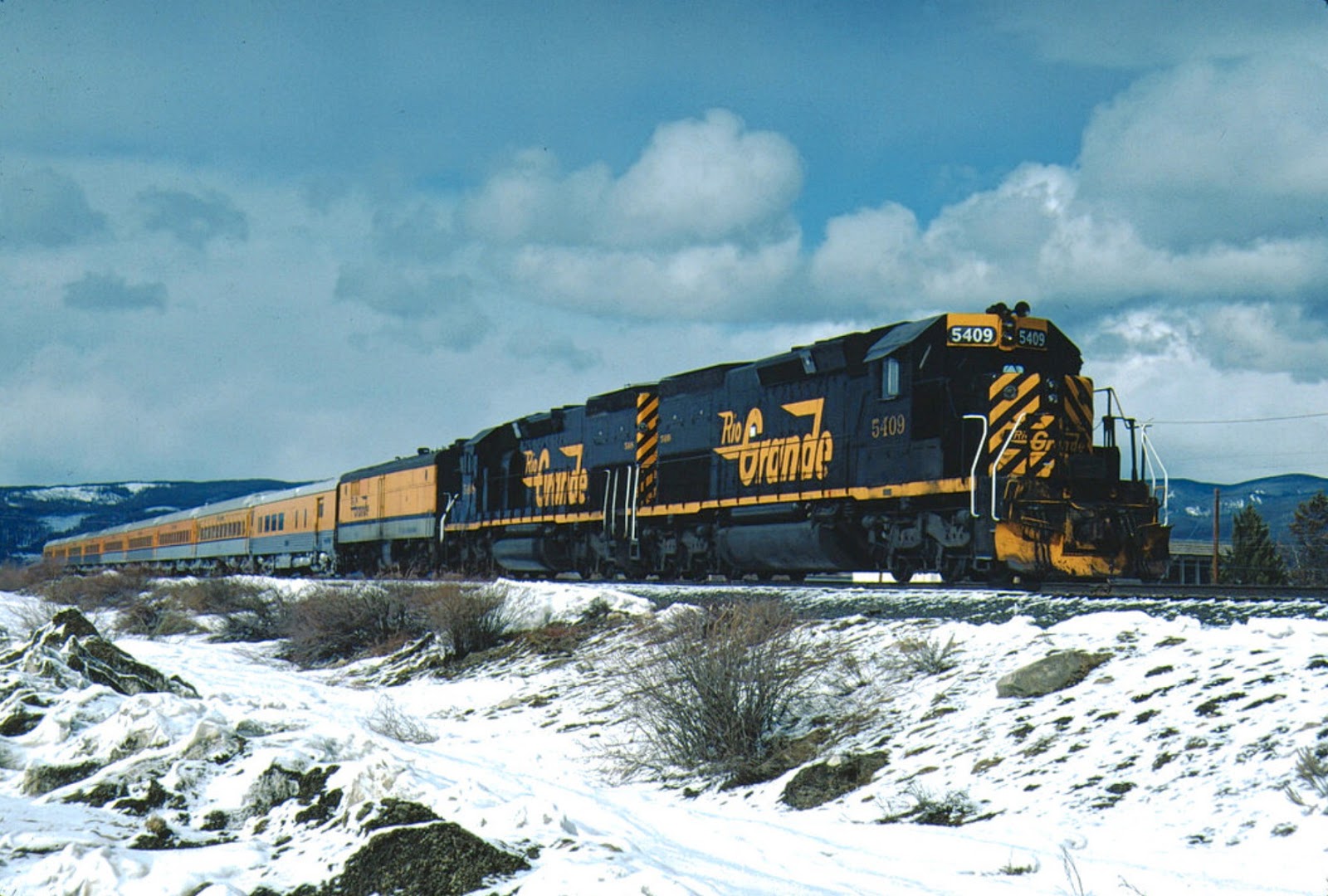
DRGW3123 leads the Ski Train west of Fraser Colorado in March 1985. Photo by Dave Ori.
Cameron Turner

Wednesday, January 8, 2020

Wordless Wednesday

UP1989 Crosses the Fraser Valley leading the ski train in February 2007. Photo by Chris May.
Cameron Turner

Sunday, January 5, 2020

To Where the Ski Train Waits

Amtrak Station Sign at Fraser Colorado. Photo from Wikipedia.
Fraser Colorado (elevation 8574') often makes the news due to it being one of the colder spots in the continental United States. It is also the Amtrak stop for Winter Park, and hosts a short siding (length 4830') that is sometimes used to store the Ski Train prior to its journey east from Winter Park to Denver. The siding is too short to be useful for most trains, but passenger trains are another story.

The town of Fraser Colorado looking West. Photo from Colorado.com.
Fraser sits in a valley between mountain ranges in the Rockies. This is the typical terrain on the western slope; the DRGW ran through an obstacle formed by a mountain range, across a valley, and then through another obstacle. Often, you find a town at each edge of the valley and one in the middle. Generally, we find a siding at each location. Understanding this configuration is important from a modeling standpoint.

West of the continental divide, we see the towns of Winter Park (siding), Fraser (siding) and Tabernash (siding) after which the DRGW passed through Fraser Canyon. The Continental Divide and Fraser Canyon become the obstacles. This pattern is repeated as the line continues west. Exiting Fraser Canyon, the mainline encounters Granby (siding) crosses the valley of Grand Park (park is a term often used for these mountain valleys) to Hot Sulphur Springs (siding) and enters Byers Canyon. Again, exiting Byers Canyon, we have the sidings of Flat and Troublesome before reaching the town of Kremmling (siding) and Gore siding before entering Gore Canyon.

If I had the space to continue west, I would look at this pattern: Obstacle - Siding - Obstacle - Siding, etc. as a plan for the layout. But for the task of modeling the Fraser Valley, specifically for Ski Train operations, I had to look at this pattern differently. Winter Park is needed since this is where the Ski Train stops to let the skiers disembark. Fraser is where Amtrak stops. Tabernash is where the Ski Train is turned and often lays over in the siding during the day, although Fraser is sometimes used once Amtrak has cleared the area. I did consider combining Fraser and Winter Park, or combining Fraser and Tabernash as an alternative, but ultimately decided to model all three.

Track Plan for Fraser.
My model of Fraser captures some of the town and the siding (83 inches long, sufficient for about a 12 car passenger train with 4 engines) and the spur track that served a lumber facility. I plan to place a small sawmill on the spur that is being used to process trees killed by the bark beetle infestation in the area. I also added a spur off the team track that can be used as a team track for the town.

Travelling the Fraser Valley.
Continuing across the Fraser Valley, the scenery is limited. There is a crossing of Saint Louis Creek, but otherwise it is ranch land. Since the track will run along a narrow shelf, this kind of "nothing-to-see-here" scenery should give a feel of separation. I did decide to place a lake or pond near the western end of the scene as a few bodies of water began to appear as the line approaches Tabernash. These features are often created by low spots flooded by the Fraser River which the line will follow through Fraser Canyon.

The Ski Train crosses the ranch lands west of Fraser. Photo from Tom Brynas.
Cameron Turner

Tuesday, December 24, 2019

The Grade West of Winter Park

The approach to the western portal of the Moffat Tunnel is also the location of a tough 2% grade stretching  from Winter Park through Fraser to Tabernash. Helper were often added to trains headed for this grade, and continued on to Denver to Provide additional dynamic breaking capabilities. These are the swing helper jobs often used on the Moffat line.

Furthermore, Fraser has a short siding which is sometimes used to hold the Ski Train, and the train is usually turned at Tabernash and usually is held there on the siding. Thus, these two locations are important to model in the western slope if one desires to model the Ski Train operations, as well as the grade approaching the western portal and the swing helper operations.

Note that on some heavy trains, swing helpers might come from Bond or Phippsburg on the Craig branch. However, as I am rapidly running out of space for such destinations, so this increases the interest in getting at least to Tabernash, and doing so without stacking these towns on top of each other.

DRGW5371 an SD40T-2, heading east between Fraser and Winter Park. Photo by Nathan Holmes. 

DRGW5390, another SD40T-2 in the same train in February 2001. Photo by Nathan Holmes.
This area is scenery, and the idea of trees fading into the snow and clouds is very attractive, even if I am not sure that it can be fully pulled off. But I would like to try.

Track Plan west of Winter Park.
This area is simple scenery. Lots of trees, and a transition from falling snow to the bright sunshine on the clean snow that often follows these storms. I managed almost 12 feet of mainline between Winter Park and Fraser, not as much as I would like, but it will be longer than all but the longest trains, and since the siding at Fraser is only 4830 feet long, the shortest on the modeled layout, that meets at Fraser will be rare, with only passenger trains likely to be passed in Fraser, this is acceptable. Most long trains will have to travel between Winter Park and Tabernash without stopping.

Cameron Turner